What Are the Best Words to Start Wordle
Discover the best words to start Wordle, compare ADIEU, SLATE, and CRANE, explore two-word strategies, and improve your chances of solving daily puzzles.
Admin
October 23, 2026
Share:
Discover the best words to start Wordle, compare ADIEU, SLATE, and CRANE, explore two-word strategies, and improve your chances of solving daily puzzles.
The best words to start Wordle test common vowels and consonants while giving you useful clues about letter positions. SLATE, CRANE, and STARE are balanced options. ADIEU and AUDIO are popular vowel-first choices, but testing four vowels does not automatically reveal the most information.
Quick answer: Start with SLATE or CRANE for balanced coverage. Choose ADIEU if you want to check several vowels immediately. There is no universally best opener: results depend on the answer list, your next guess, and whether you want fewer guesses or a lower risk of losing.
The supplied chart covers 515 million Wordle games completed between December 1, 2022, and November 30, 2023. It shows what players chose, not which word produced the highest win rate.
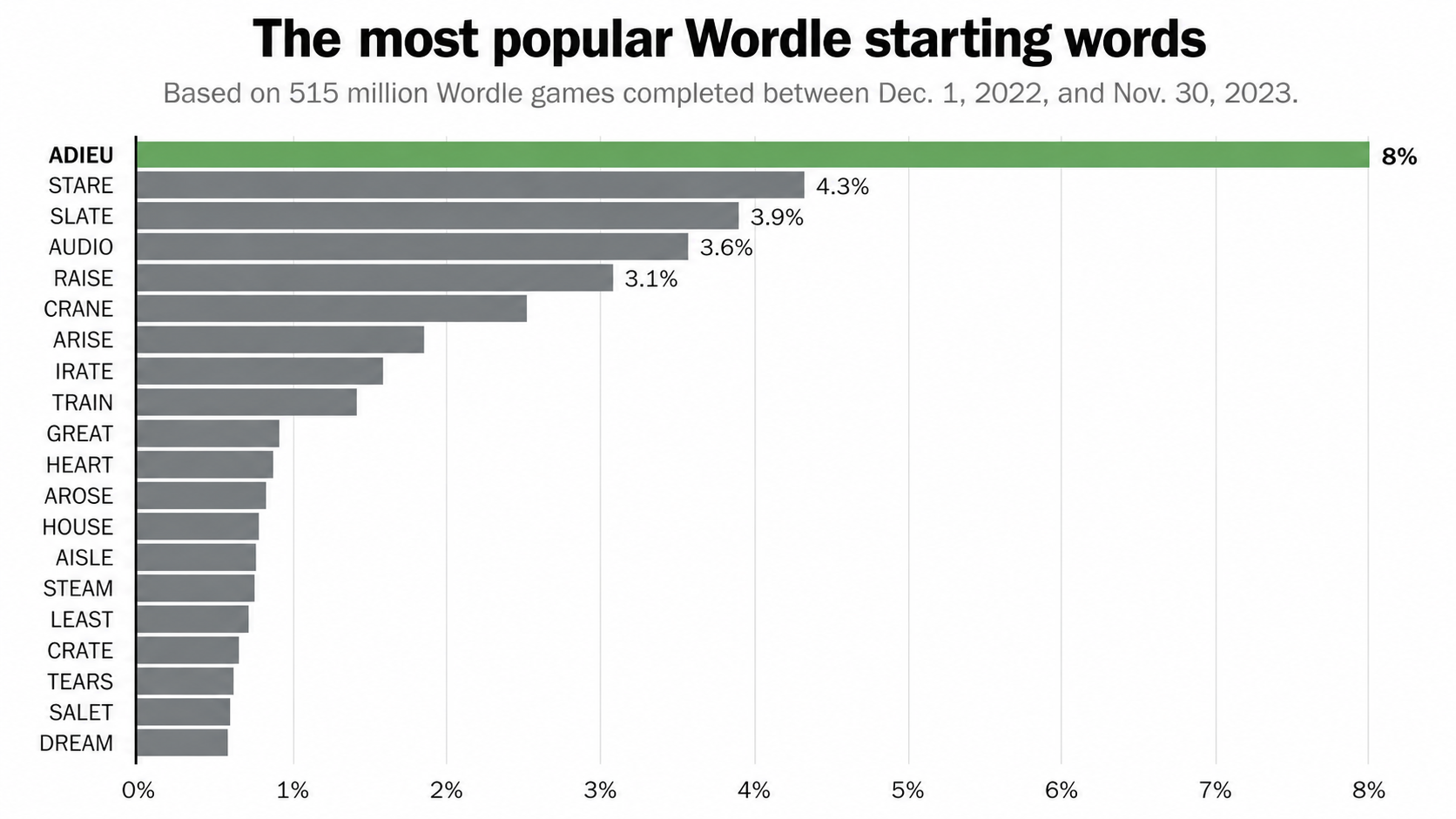
Word | Share of games | Why players choose it |
ADIEU | 8.0% | Tests four vowels |
STARE | 4.3% | Mixes common consonants and vowels |
SLATE | 3.9% | Balanced coverage |
AUDIO | 3.6% | Tests four vowels |
RAISE | 3.1% | Combines common letters |
The chart also features CRANE, ARISE, IRATE, TRAIN, GREAT, HEART, AROSE, HOUSE, AISLE, STEAM, LEAST, CRATE, TEARS, SALET, and DREAM. Exact percentages for these lower bars are not labelled, so they should not be guessed.
ADIEU and AUDIO check four vowels but only one consonant each. You may learn that the answer contains A or E, yet still have many possible words left. Common consonants such as R, S, T, L, and N remain unknown.
By comparison, SLATE, CRANE, and SALET combine vowels with useful consonants and avoid repeated letters. This makes them strong candidates for information-focused play. Still, no word is always best. A fair ranking must specify the answer list and whether it measures average guesses, solve rate, worst-case results, or information gained.
Word | Vowels | Common Consonants | Best For | Typical Success Profile |
ADIEU | A, I, E, U | D | Vowel-first play | Broad vowel check, limited consonant clues |
AUDIO | A, U, I, O | D | Vowel-first play | Tests four vowels, one consonant |
SLATE | A, E | S, L, T | Balanced strategy | Useful mix, not guaranteed to be optimal |
CRANE | A, E | C, R, N | Balanced strategy | Tests common consonants and two vowels |
STARE | A, E | S, T, R | Everyday play | Balanced letter coverage |
RAISE | A, I, E | R, S | Broad coverage | Three vowels and two consonants |
Letters E, A, R, O, T, L, S, and N are useful because they are common in English, but Wordle's answer list is not a random sample of the language. Position matters too: green fixes a letter's position; yellow confirms the letter appears elsewhere. Repeated letters can complicate gray feedback, so check the whole pattern before eliminating a candidate.
Which opener should you choose?
· Everyday play: SLATE, CRANE, or STARE.
· Vowel discovery: ADIEU or AUDIO, followed by a consonant-rich guess.
· Streak protection: Track candidate words carefully instead of chasing a supposedly perfect opener.
· Hard Mode: Adapt your next guess to the clues already revealed.
Some players plan two opening guesses to test ten unique letters. These pairs cover more of the alphabet, but the second guess uses one of your six turns and may be less useful than adapting to the first result.
Mode | First Word | Second Word | Coverage |
Standard | RAISE | POUTY | Ten unique letters |
Standard | SLATE | ROUND | Ten unique letters |
Standard | CRANE | TOILS | Ten unique letters |
Standard | STARE | COULD | Ten unique letters |
Hard Mode | SLATE | Choose from feedback | Must obey revealed clues |
Hard Mode | CRANE | Choose from feedback | Must obey revealed clues |
These are coverage examples, not proven optimal pairs. In Hard Mode, a fixed second word may be illegal if it ignores a green or yellow clue. A smarter approach is to record every color, remove impossible candidates, then choose a guess that separates the remaining options. Do not sacrifice useful clues just to test five new letters.
Reddit discussions compare SLATE, CRANE, RAISE, and ADIEU, plus pairs designed to test ten letters. They offer useful ideas, but individual comments are not controlled benchmarks.
A Science Foundation Ireland article describing Professor Barry Smyth's Wordle simulator reported TALES as a strong single-word opener and CONES followed by TRIAL as a tested two-word strategy. Those findings belong to that study's simulation and answer pool, not every version of Wordle.
For another perspective, read the official NYT Wordle Bot analysis. Its recommendations can help explain strategic choices, but rankings depend on the model, rules, and metric.
NYT Solvers is a resource for puzzle enthusiasts who want to work through tricky patterns. Try daily Wordle hints for a quick nudge first instead of spoiling the answer right away. If several candidates remain, the interactive Wordle solver can help organize possibilities. For a wider comparison, see best Wordle solver tools.
Enter feedback accurately, check repeated letters, and treat suggestions as reasoning aids rather than instructions to follow blindly.
For most players, SLATE, CRANE, or STARE is a sensible opener because each combines common vowels and consonants. Choose ADIEU or AUDIO if you prefer vowel-first play, but recognize what they leave untested.
The best strategy is not a magic word. Read the colors carefully, account for repeated letters, and make each guess respond to what you have learned.
Not exactly. It is useful for vowel discovery, but tests only one consonant. Follow it with a guess that checks common consonants and respects the clues.
SLATE and CRANE are practical, balanced choices. ADIEU leads the supplied popularity chart, but popularity does not prove better solving performance.
You can, but a consistent opener makes it easier to learn its patterns and compare results. One unlucky game is not enough to judge a word.
A fixed pair tests more letters but uses two of six guesses. An adaptive second guess may be better when the first guess reveals useful information.
Consider E, A, R, O, T, L, S, and N, but do not rely on frequency alone. Position and feedback determine how useful a guess becomes.
You must follow revealed clues in later guesses. Keep green letters in place and include yellow letters in different positions, adapting your second guess to the feedback.
Continue your learning journey with these related articles
Learn the proven strategies and starting word techniques to solve Wordle faster and maintain your streak.
Discover how to find all valid words, pangrams, and reach Genius or Queen Bee ranking.
Master theme words, spangrams, and grid scanning with this in-depth guide to NYT Strands.